

If you’re like so many of us, you are probably reading this in your email inbox right now.
Do you ever pause to reflect on just how incredible this is? The idea that anyone can write something, publish it online, and you can read it — whenever and wherever you want. For free.
It wasn’t always this way.
Before the web, there was Gutenberg.
Gutenberg
Do you know the history of the Gutenberg printing press?
In 1436 Johaness Gutenberg, a German goldsmith, began designing a machine capable of producing pages of text at an incredible speed—a product that he hoped would offset losses from a failed attempt to sell metal mirrors. By 1440 Gutenberg had established the basics of his printing press including the use of a mobile, reusable set of type, and within ten years he had constructed a working prototype of the press. In 1454 Gutenberg put his press to commercial use, producing thousands of indulgences for the Church. The following year he printed his famous 42-line Bible, the first book printed on a moveable type press in the West.1 (source)

It’s hard to overstate the impact of this innovation:
Johannes Gutenberg’s moveable type press marked the beginning of the Printing Revolution in the western world, a colossal moment in the history of information and learning. With access to printing presses, scientists, philosophers, politicians, and religious officials could replicate their ideas quickly and make them available to large audiences. (source)

Books
Growing up, I took books for granted. I was lucky to live in a city with the world’s largest independent bookstore: Powell’s. Wandering up and down the aisles, it can seem like there is a book about nearly any topic imaginable.
Magazines and newspapers
When I was a kid, there was a cigar store downtown named Rich’s that my dad would visit sometimes to buy an out-of-town newspaper. I loved it when he took me — not because either of us smoked but because they had hundreds of magazines and dozens of newspapers from all over the world. I loved to browse the titles.
Web
When I first discovered the world wide web in the early 1990s, I sensed it could change the world. I’ve written about the early days of the web in my Web 30 series earlier this year. Here I’ll highlight two things that excited me then and still do today:
Power of hyperlinks: No longer did we have to live with just a footnote and trudge to the library to look up the referenced book or research article; now you could directly link to the source!
Democratized publishing: No longer was publishing only in the hands of major publishing houses and media companies. If someone had something to contribute, they now could — directly.
Still, in those early days, it required some technical skills. Over time, it got easier and more accessible to the masses.
Six Apart
In 2001, Ben and Mena Trott launched Movable Type, an early pioneer in blogging software. Mena had started writing a blog, Dollarshort. As NBC News reported in 2005:
As Mena blogged, Ben became frustrated in his search for a decent computer programming job. While unemployed, Ben began to work on the computer code that became Movable Type.
When 100 people downloaded Movable Type during the first hour of its release in September 2001, the Trotts decided to run their own business from their bedroom, drawing the inspiration for the company name from their nearly identical age -- Ben and Mena were born six days apart in 1977….
Decades later, this origin story is still referenced on the Moveable Type website:
Movable Type was created by a husband and wife team with a single purpose: to create a powerful solution for the creation and management of web content. An originator of the blogging field, Movable Type offers stability, a user-friendly interface, and beautifully extensive visual customization for websites and blogs.
In 2003, venture capitalist Joi Ito invested in Ben and Mena’s company, Six Apart, and the company and its products began to scale. His wiki described the company this way: “Six Apart creates tools that enable tens of thousands of individuals, organizations, and corporations to participate in the web’s full potential by publishing their ideas on the Internet with simple, yet powerful software and services.”
TypePad
In July 2003, I started testing a new Six Apart offering, TypePad, which was essentially a hosted version of Moveable Type. Here was my first post:

After a month of testing, I decided to keep using it. Here was a post I made at that time:

By that fall, I was thinking of adopting TypePad for a new personal blog:

A few weeks later (on November 7, 2003), I wrote a post noting in part:
Online, the tension between a desire for community and a need for personal privacy continues. I’ve spent the better part of the last nine years wrestling with this very issue. And, on the eve of considering the launch of a new personal blog, I’m still conflicted.
It’s something that I continue to wrestle with to this day. I wrote about it in 2023:

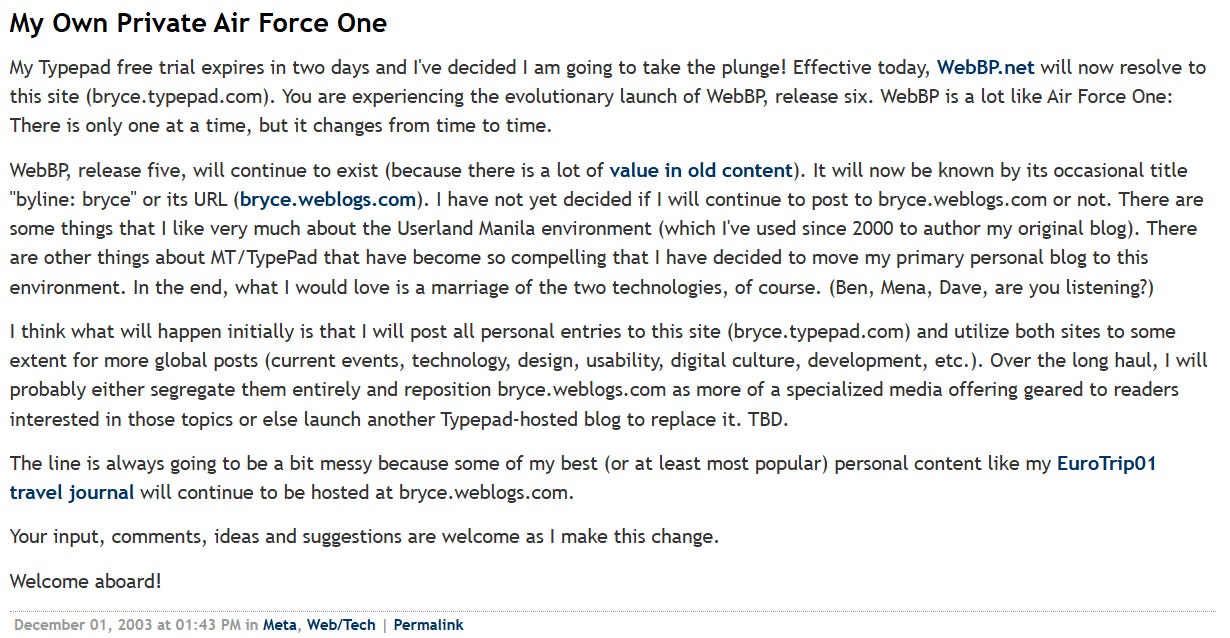
By December 2003, however, I had decided to formally adopt TypePad as a web publishing platform, writing at the time:
Many others did, too. ABC, BBC, MSNBC, Time, and Wired were among the media companies that used TypePad.
Later that same year, I received a card from a dear friend who wrote:
Every so often I take a look-see at your weblog and without fail, there is always something interesting...you’ve always been something of a trends & issue spotter. And, I’d have little notion of the blog universe in the absence of yours.
I thanked my friend for the kind words — and kept going.
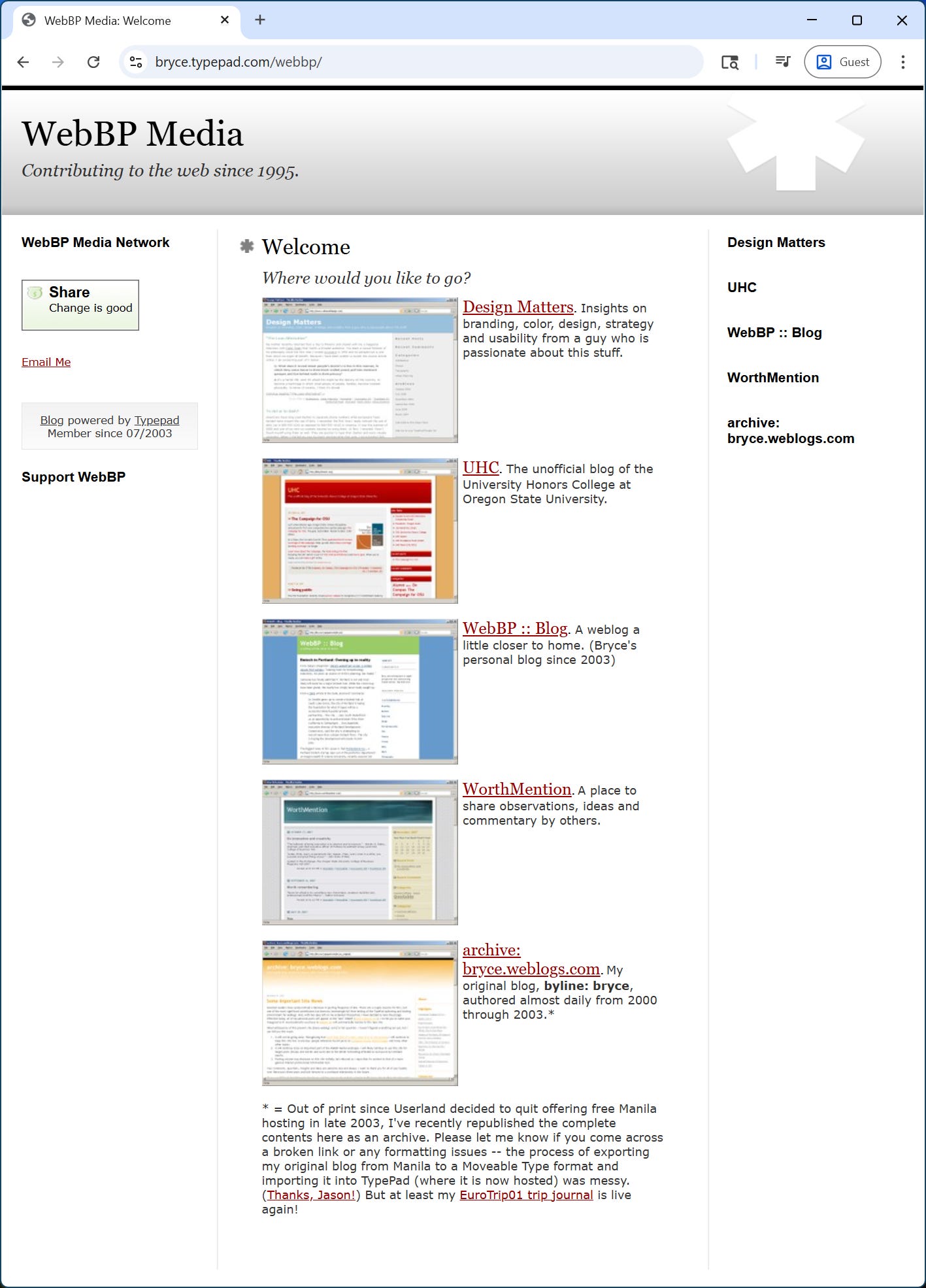
Over time, Typepad would become home to multiple publications. Here is a screenshot of a legacy WebBP Media home page featuring a few.
In 1998, Jakob Nielsen, named the “guru of web page usability” by The New York Times, wrote web pages must live forever. I read Jakob’s bi-weekly column regularly for many years and his research and insights influenced my views on web design and usability.
I share this because it helps to explain why I have continued to pay for TypePad each year even though I haven’t posted new content on the platform in several years.
Alas, nothing lasts forever.
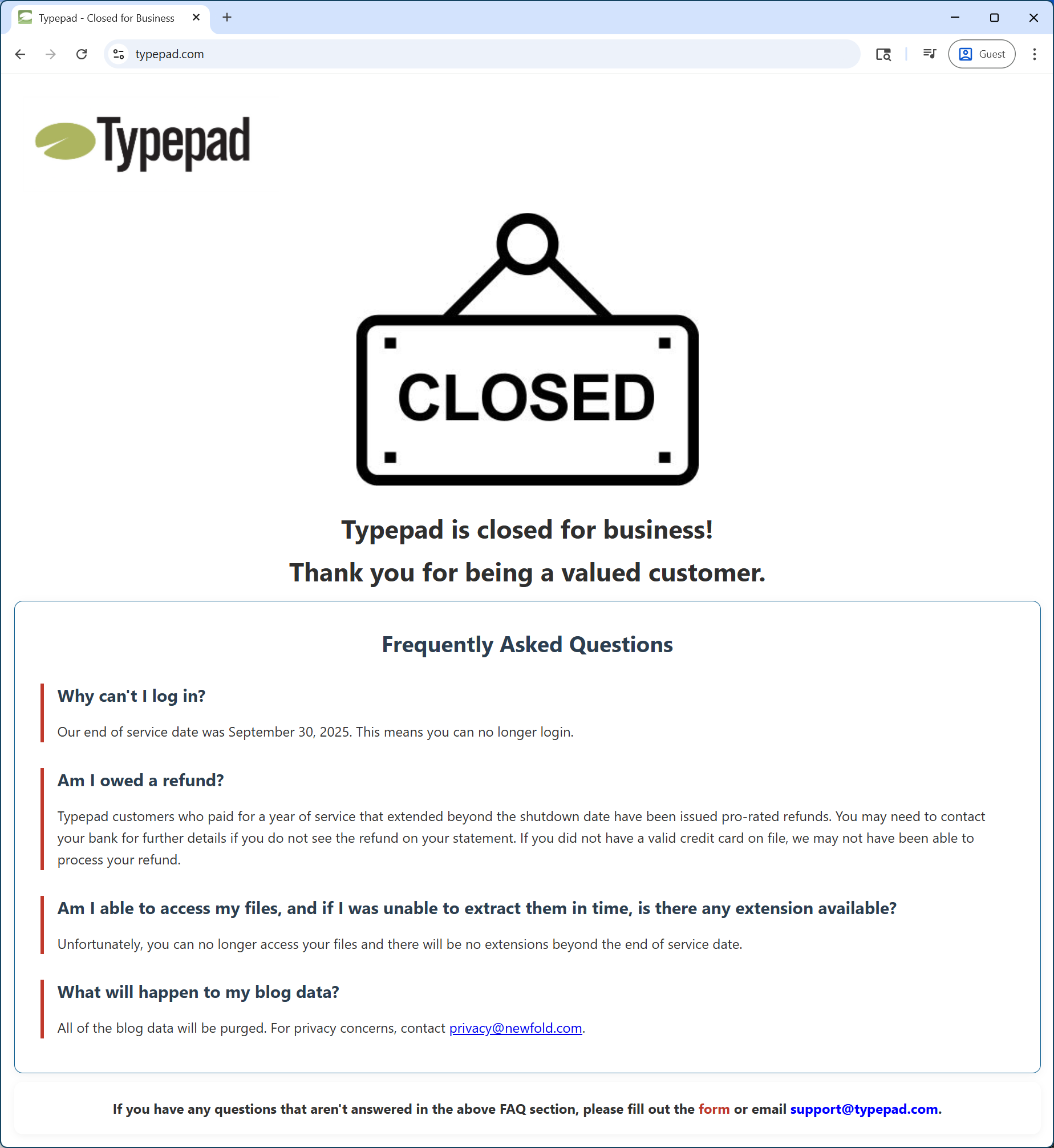
Typepad shut down on September 30, 2025.
What have I learned?
Nothing lasts forever, even if you pay.
It’s better to move with the times than to stay to the bitter end.
Seth Godin moved off TypePad in 2018 with help from a team including Auttomatic, maker of WordPress. Every year since, I’ve thought about doing the same but never found the time or team to make it a reality. I tried the Substack import tool in 2022 but it didn’t import beyond 10 posts so I made peace that Bryce's Blog would start new, just as WebBP::Blog did in 2003.
Maybe one day if I find the time I will create a WordPress site, import the MoveableType export into WordPress, export and then import into Substack. But if I’m being realistic, probably not. And given that the export didn’t include images and other items, it would likely be a low fidelity version of the original. (If you have the skills to do this and want to help, email me.)
Sometimes the universe will make a decision for you.
Each January, I’ve debated about whether or not to renew my Typepad subscription. Next year, I won’t have to.
If you’ve read this far, thank you.
More about Ben and Mena, Six Apart, and TypePad
Here are a few other articles that I found during my research for this issue that you may find interesting.
Birth of a blogging behemoth (NBC News, 2/22/2005)
Why the Design of this Site Will Never Change (Kevin Smokler, 1/6/2005)
Blog Tool Writing Its Own Story of Success (LA Times, 3/7/2005)
Meet the founder of the blog revolution (Mena Trott, TED, 2/2006)
Interview with blogging pioneer Mena Trott (Oliver Lindberg, Medium, 6/18/2007)
Farewell, Six Apart. (Mena Trott, Dollarshort, 9/22/2010)
WordPress, Six Apart silences and communities (Adam Tinworth, 2/10/2011)
Kottke.org posts about Mena Trott (Jason Kottke, Kottke.org, 2006-2012)
My Divorce Sense is Tingling (or: “Okay, Malcolm Gladwell, you win.”) (Joey deVilla, 5/1/2013)
🎵 Blogging by Wire
Here is this week’s embed: a track called Blogging by Wire about our digital world.
Be well,
-Bryce
Bryce, thanks for reviving such unforgettable memories.
A very big part of my journey online has been through the publishing of MasterNewMedia.org on MovableType (2002-2014). A few years back, I realized that the software - which I had not been updating for the longest time - wasn't usable anymore, and wondered - like you - what to do with all that glorious content published over so many years.
My choice has been to identify the top 150 articles, in the 3,000+ I had published and bring them back to survive the test of time outside of MT. I found a reliable editor on Upwork, and we have manually checked, revised, and reformatted by hand all those articles which now live on MasterNewMedia.com hosted on Medium. for apx $50/year I am pretty happy with the results.
Yes, as Jakob said, content online should live forever. And this is always a deep interesting topic to follow. Thanks again for your contribution.